
Economic Systems: How Societies Decide What to Produce
Learn how societies answer the basic economic questions through command, free market, and mixed economies.
- Understand why economic systems matter
- Identify the main economic questions societies must answer
- Learn the difference between command, free market, and mixed economies
- Understand the pros and cons of each economic system
- Explain free markets, allocative efficiency, and the circular flow diagram
Introduction
Every country, as we mentioned before, has limited resources. Since we have limited resources, we have to make choices. These choices are answered through an economic system. For instance, a system decides how goods and services are produced and consumed.
Why this matters
Economic systems matter because they help societies decide what to produce, how to produce it, and who receives what is produced. These decisions affect prices, jobs, businesses, government services, inequality, and the daily lives of people.
The main idea
Economists should always ask key questions. The first question is: what should be produced? How much, if any, of each good or service should be produced?
For example, should a country produce more food, schools, or military equipment?
The second question is: how should goods and services be produced? Should production use more workers or machines? Should we focus on cheap production or environmentally friendly production?
The third question is: who will get what is produced? Who will get how much of each good or service produced?
Beyond these questions, we have economic systems, but what are economic systems?
An economic system is, basically, the way a society organizes production and consumption. We have three main types of economic systems: government command economy, capitalism or free market economy, and a mix of both, known as a mixed economy.
A command economy, or government-controlled system, is when the government decides what to produce, how to produce it, and who receives it. The government basically decides everything. It sets prices, owns many industries, and decides production targets.
One advantage of a command economy is that it can focus on basic needs like healthcare and education.
It could also help promote healthier habits, such as reducing smoking or other harmful behaviors.
It could focus on making important goods, like books, more affordable, and it can organize resources quickly during crises.
However, a command economy is really hard to maintain, even with the help of computers, and mistakes can always appear.
There is also less freedom for businesses and consumers.
It could be inefficient and less innovative, leading to less competition.
This could also risk shortages or poor-quality goods.
Capitalism, or a free market economy, basically depends on supply and demand.
Individuals and businesses make most of the economic decisions, and prices are influenced by supply and demand. Moreover, businesses compete to attract customers.
One advantage of capitalism is that it encourages innovation and competition.
It gives consumers more freedom of choice.
It also helps achieve allocative efficiency. Allocative efficiency means that resources are used to produce the goods and services that people value most. This idea is connected to economists such as Léon Walras, who contributed to the study of markets and general equilibrium.
In a free market, businesses try to reduce costs, improve products, and respond to what people demand. Demand helps decide prices, and capitalism answers the economic questions with limited government involvement.
However, capitalism can create inequality, and some people may not afford basic needs.
Businesses may focus on profit over workers or society.
Sometimes markets fail without rules.
However, in real life, an economy cannot be purely capitalist, as the government will always make sure the economy is competitive and fair.
A mixed economy basically combines both government control with free market activity.
For example, private businesses sell products, while the government provides public schools, taxes, infrastructure, and services. The government may also regulate businesses to protect consumers and workers.
One advantage of a mixed economy is that it creates a balance between protection and freedom.
It allows businesses to innovate while the government supports the basic needs of people.
It can also reduce market failures.
However, if the government controls too much, this could slow business growth.
If the government controls too little, this can lead to inequality.
So, it always depends on finding the right balance, which is hard to achieve.
Most countries are mixed economies. Real life is more complicated than theory.
Every capitalist country has taxes and government spending, for instance. Even command economies cannot control everything. They may allow some private businesses and markets.
Using both systems has strengths and weaknesses.
A free market is a market where buyers and sellers, also known as producers and consumers, make decisions with limited government interference. Prices help show what people want and how scarce something is.
A limitation of a free market is that it is not always perfect. It may ignore issues like pollution and poverty if they are not profitable.
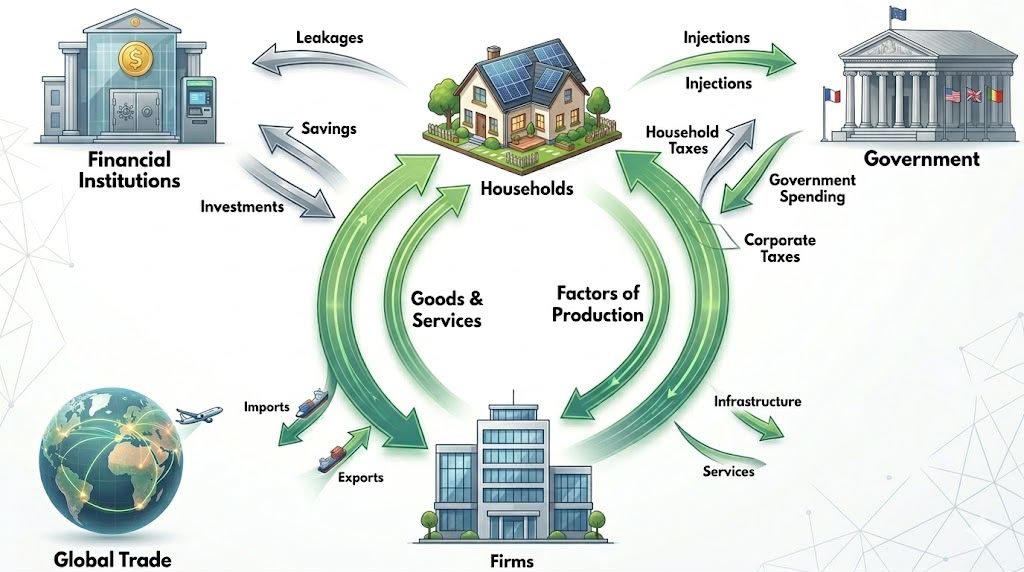
Last but not least, the circular flow diagram is a diagram that shows how money, goods, services, and resources move in an economy.
It has main parts: households, firms, the market for resources, and the market for goods and services.
Households provide resources, such as labor, to firms. In return, firms pay households wages, profits, rent, or income.
Then, firms use these resources to produce goods and services. Households use their income to buy these goods and services from firms.
So, money flows in one direction, while goods, services, and resources flow in the other direction.
For example, if a country has limited resources, it must decide whether to produce more schools, food, hospitals, or military equipment. A command economy would let the government decide this. A free market economy would let consumers and businesses decide through supply and demand. A mixed economy would use both private business decisions and government involvement.
Practical steps you can take
- 1
Ask what goods and services should be produced
- 2
Ask how those goods and services should be produced
- 3
Ask who will receive what is produced
- 4
Identify whether the economy gives more power to the government, the market, or both
- 5
Look at whether prices are mostly decided by supply and demand or by government control
- 6
Think about whether the system protects basic needs while still allowing innovation
- 7
Use the circular flow diagram to understand how households, firms, money, goods, services, and resources move in an economy
Common mistakes to avoid
- Thinking that capitalism means there is no government involvement at all.
- Thinking that command economies can easily control everything perfectly.
- Forgetting that most countries are mixed economies.
- Confusing free markets with mixed economies.
- Forgetting that free markets can sometimes fail without rules.
- Thinking that profit always leads to the best outcome for society.
- Forgetting that the circular flow diagram shows both money flow and resource flow.
Why do you think most countries use a mixed economy instead of being purely capitalist or purely command?
Take 60 seconds. Write your answer in a notebook or notes app.
Key takeaways
- Economic systems help societies answer the main economic questions.
- The main questions are what to produce, how to produce, and who receives what is produced.
- A command economy is controlled mainly by the government.
- A free market economy depends mainly on supply, demand, and private decision-making.
- A mixed economy combines government control with free market activity.
- No economy is purely capitalist or purely command in real life.
- Free markets can encourage efficiency, innovation, and choice.
- Free markets may also ignore issues like poverty and pollution if they are not profitable.
- The circular flow diagram shows how money, goods, services, and resources move between households and firms.
Why are most economies considered mixed economies?
Ready to lock it in?
Take the weekly quiz to earn your badge and track your progress.
Take the weekly quiz